
Ratio Simplifier: Reduce Ratios to Their Simplest Form
Use a ratio simplifier to reduce whole numbers, decimals, fractions, and three-part ratios. Learn GCF methods, check your answers, and avoid common mistakes.
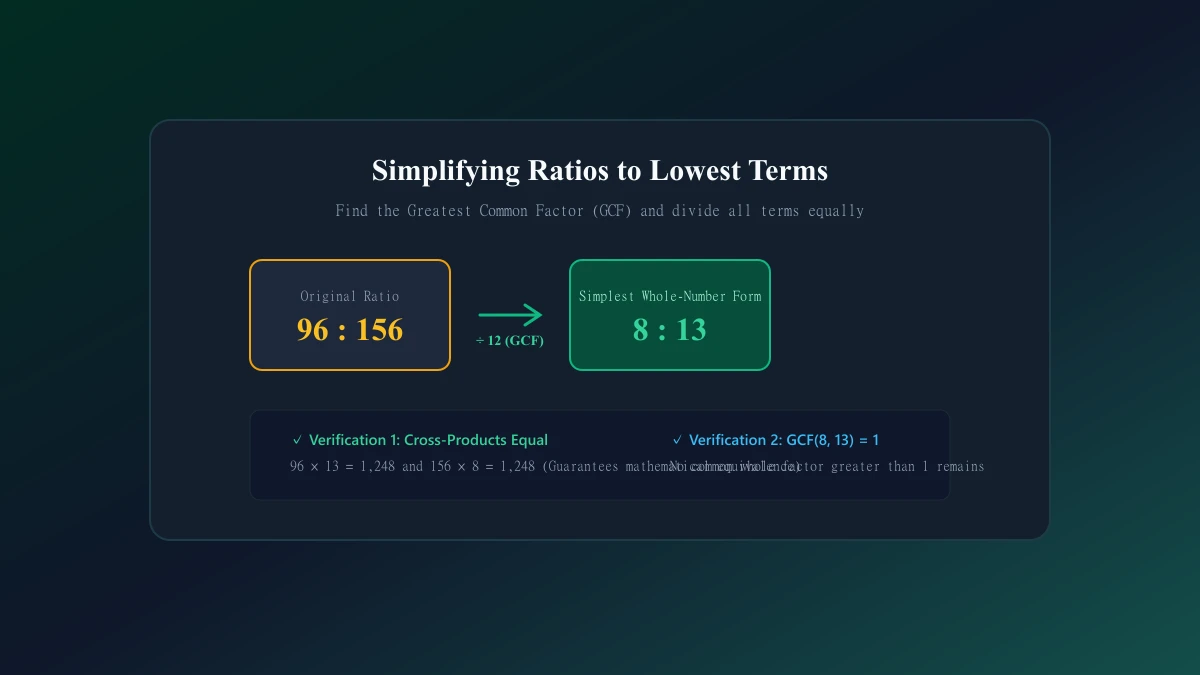
Table of Contents
- Quick Answer: The Rule for Reducing a Ratio
- Entering Values Into a Ratio Simplifier
- Whole Numbers: Find the Factor Shared by Every Term
- Work Through 96:156
- Reduce in Stages When the GCF Is Not Obvious
- Prime Factorization for Large Numbers
- How to Simplify Ratios With Decimals
- Example: 0.875 : 1.25
- Example: 2.4 : 0.36
- Fractions and Mixed Numbers: Clear the Denominators
- Two Fractional Terms
- Mixed-Number Terms
- Convert Units Before Looking for Common Factors
- Three or More Terms Must Be Reduced Together
- Lowest Whole-Number Terms Versus 1:n Form
- Check That the Answer Is Equivalent and Fully Reduced
- Practice Across Different Input Types
- Frequently Asked Questions
- How do I know if a ratio is fully simplified?
- Can zero appear in a simplified ratio?
- Does simplifying change the actual quantities?
- Keep the Reduction Exact From Start to Finish
A ratio simplifier reduces a comparison to its smallest equivalent whole-number terms. For a ratio such as 96:156, it finds the greatest common factor, 12, and divides both values by it. The result is 8:13, with the original relationship preserved.
Whole numbers usually need only that final division. Decimal ratios may first need a common multiplier to remove decimal places, while fractions need a shared denominator. Measurements written in different units require conversion before either step makes sense.
The aim is an exact answer, not merely a shorter-looking one. Rounding, changing only one term, or forcing a value to become 1 can produce a different result from the requested simplest whole-number form. Understanding the process helps you recognize when a calculator has finished the job and when the input needs attention first.
Quick Answer: The Rule for Reducing a Ratio
To simplify a ratio, express comparable measurements in matching units and clear any fractions or decimals. Find the greatest common factor (GCF) of all resulting whole numbers, then divide every term by it. The ratio is fully reduced when no whole number greater than 1 divides all its terms.
Entering Values Into a Ratio Simplifier
For the most reliable results:
- Choose the simplification mode if the tool offers several operations.
- Enter every term in its original order.
- Confirm whether the tool supports decimals, fractions, or mixed numbers.
- Convert measurement units yourself unless the tool explicitly handles them.
- Read both the reduced ratio and any displayed calculation steps.
Do not confuse a decimal quotient with a simplified ratio. Entering $96 \div 156$ into an ordinary calculator gives approximately $0.61538$. That is a numerical value of the comparison, but it does not directly display the exact whole-number pair 8:13.
Whole Numbers: Find the Factor Shared by Every Term
When simplifying ratios of positive integers $a$ and $b$, let $g$ be their greatest common factor:
$$a:b = (a \div g) : (b \div g)$$
Work Through 96:156
Both terms divide evenly by 12:
- $96 \div 12 = 8$
- $156 \div 12 = 13$
Therefore, 96:156 = 8:13.
Since 8 and 13 have no shared factor greater than 1, the reduction is complete.
Reduce in Stages When the GCF Is Not Obvious
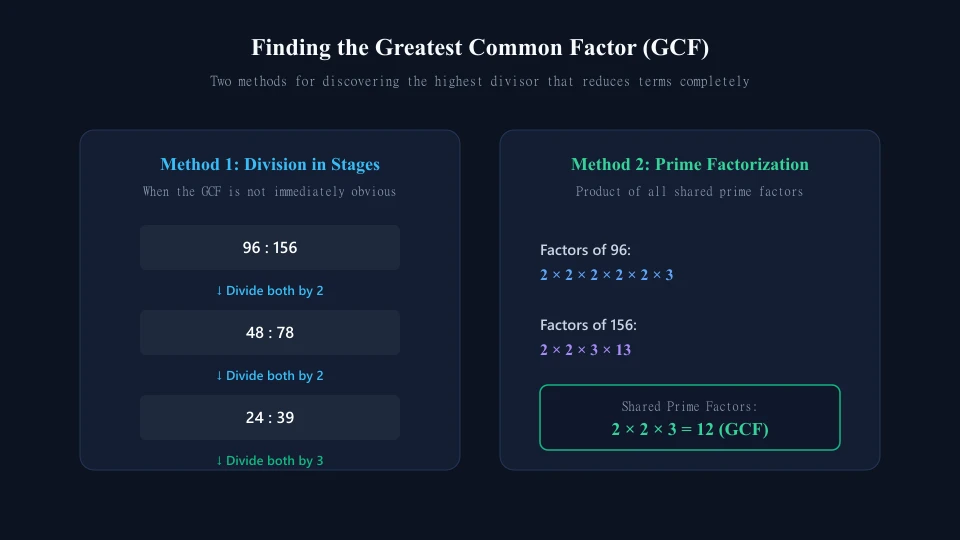
You can reach the same result through smaller common divisors:
$$96:156 \xrightarrow{\div 2} 48:78 \xrightarrow{\div 2} 24:39 \xrightarrow{\div 3} 8:13$$
The successive divisors are 2, 2, and 3 ($2 \times 2 \times 3 = 12$, matching the GCF).
Prime Factorization for Large Numbers
For larger values, break down numbers into primes:
- $96 = 2^5 \times 3$
- $156 = 2^2 \times 3 \times 13$
- Shared primes: $2^2 \times 3 = 12$ (the GCF).
How to Simplify Ratios With Decimals
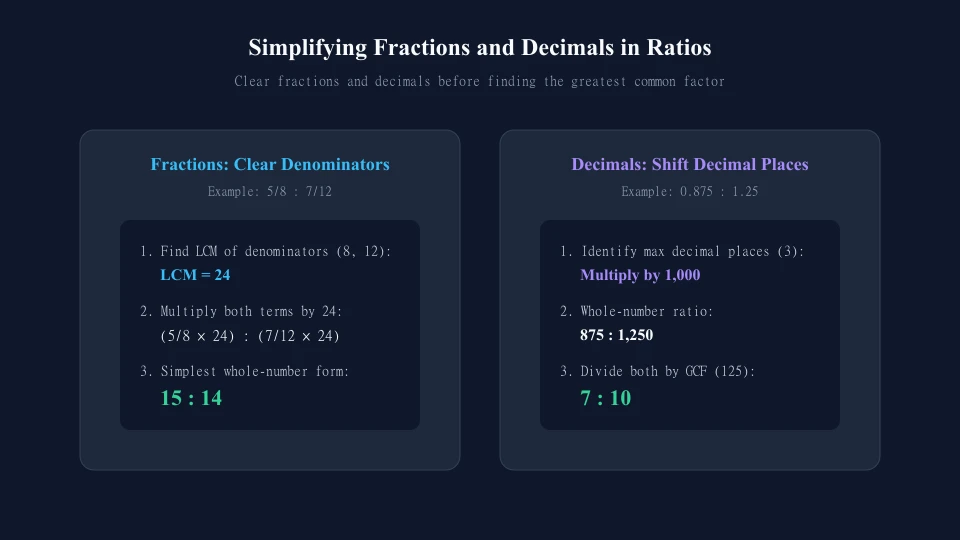
Decimals are valid ratio terms. To express them in whole-number form, multiply every term by the same power of 10, then reduce.
Example: 0.875 : 1.25
- The first term has 3 decimal places; multiply both by 1,000: $$0.875 : 1.25 = 875 : 1,250$$
- The GCF is 125:
- $875 \div 125 = 7$
- $1,250 \div 125 = 10$
- Simplest form is 7:10.
Example: 2.4 : 0.36
Multiplying both values by 100 gives $240:36$. Dividing both by 12 produces 20:3.
Fractions and Mixed Numbers: Clear the Denominators
Two Fractional Terms
Simplify: $\frac{5}{8} : \frac{7}{12}$
- The LCM of 8 and 12 is 24. Multiply both by 24: $$\left(\frac{5}{8} \times 24\right) : \left(\frac{7}{12} \times 24\right) = 15 : 14$$
- Since 15 and 14 share no common factor, the answer is 15:14.
Mixed-Number Terms
For $1\frac{3}{5} : 2\frac{2}{3}$:
- Convert to improper fractions: $\frac{8}{5} : \frac{8}{3}$
- Multiply by $\text{LCM}(5, 3) = 15$: $$\left(\frac{8}{5} \times 15\right) : \left(\frac{8}{3} \times 15\right) = 24 : 40$$
- Divide both by 8: 3:5.
Convert Units Before Looking for Common Factors
A numerical reduction is meaningful only when quantities are expressed on a consistent basis.
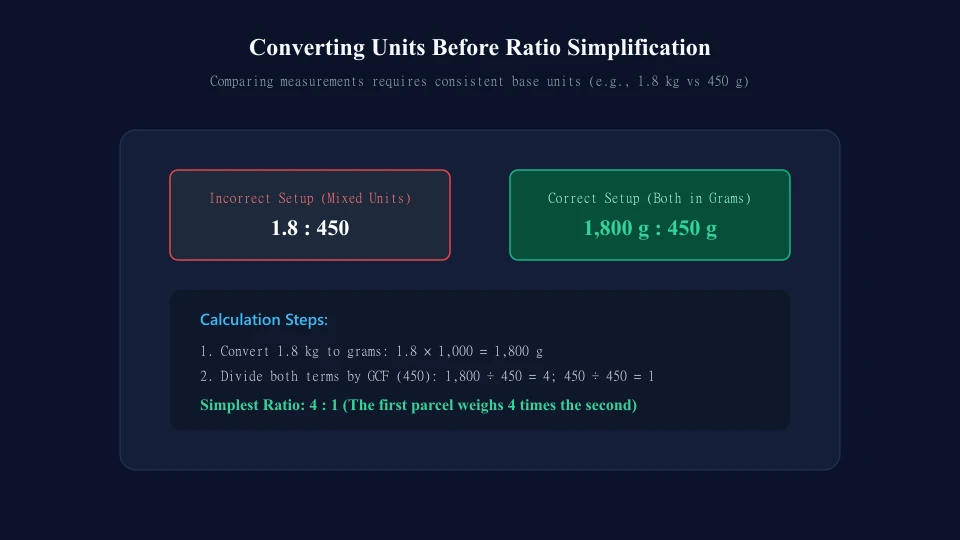
Suppose two parcels weigh 1.8 kg and 450 g:
- Convert kilograms to grams first: $1.8\text{ kg} = 1,800\text{ g}$
- Now simplify: $1,800 : 450$
- Divide both by 450: 4:1 (The first parcel weighs four times as much as the second).
Three or More Terms Must Be Reduced Together
To simplify a ratio of three numbers, find a divisor shared by all three, not merely one pair.
Consider 42 : 70 : 105:
- The greatest common factor across all three numbers is 7:
- $42 \div 7 = 6$
- $70 \div 7 = 10$
- $105 \div 7 = 15$
- Result: 6 : 10 : 15
Although 6 and 10 share a factor of 2, and 10 and 15 share 5, no factor divides all three. The ratio is fully simplified!
Lowest Whole-Number Terms Versus 1:n Form
| Requested Format | Result for 14:35 | Notes |
|---|---|---|
| Simplest whole-number ratio | 2:5 | Smallest integer pair (divide by GCF 7) |
| Form 1:n | 1:2.5 | Normalized to 1 unit of first term ($35 \div 14$) |
| Form n:1 | 0.4:1 | Normalized to 1 unit of second term ($14 \div 35$) |
| Fraction (first $\div$ second) | 2/5 | Decimal value = 0.4 |
Check That the Answer Is Equivalent and Fully Reduced
- Equivalence Check: For $a:b = c:d$, verify cross-products $a \times d = b \times c$. For $96:156 = 8:13$, $96 \times 13 = 1,248$ and $156 \times 8 = 1,248$.
- Coprime Check: Confirm that $\text{GCF}(c, d) = 1$.
Practice Across Different Input Types
| Original Ratio | Simplest Form | Key Step |
|---|---|---|
| 99 : 165 | 3:5 | Divide both terms by 33 |
| 0.56 : 1.4 | 2:5 | Multiply by 100 ($56:140$), then divide by 28 |
| 3/10 : 9/20 | 2:3 | Multiply by 20 ($6:9$), then divide by 3 |
| 24 : 40 : 60 | 6:10:15 | Divide all three terms by 4 |
| 2.5 hours : 40 mins | 15:4 | Convert 2.5 hours to 150 minutes, then divide by 10 |
Frequently Asked Questions
How do I know if a ratio is fully simplified?
All terms must be whole numbers, and their collective greatest common factor must equal 1.
Can zero appear in a simplified ratio?
Yes, for absent categories ($0:12 \to 0:1$). However, $0:0$ is mathematically undefined.
Does simplifying change the actual quantities?
No. Reducing 60:84 tickets to 5:7 changes the mathematical representation, not the physical count of tickets.
Keep the Reduction Exact From Start to Finish
A ratio simplifier is most useful when you prepare consistent inputs, apply the same operation across all terms, and distinguish lowest integer terms from normalized 1:n form.
BigTechies Editorial Team
The Ratio Solver editorial team specializes in clear, step-by-step mathematical guides, statistical analysis explanations, and practical calculation workflows for students, educators, and professionals.
Solve Any Ratio in Seconds With Our Free Calculator
Simplify whole numbers, fractions, and decimals, find missing values, or divide totals in proportional parts with verified instant accuracy.
Related Articles
Continue exploring practical calculation guides and tutorials
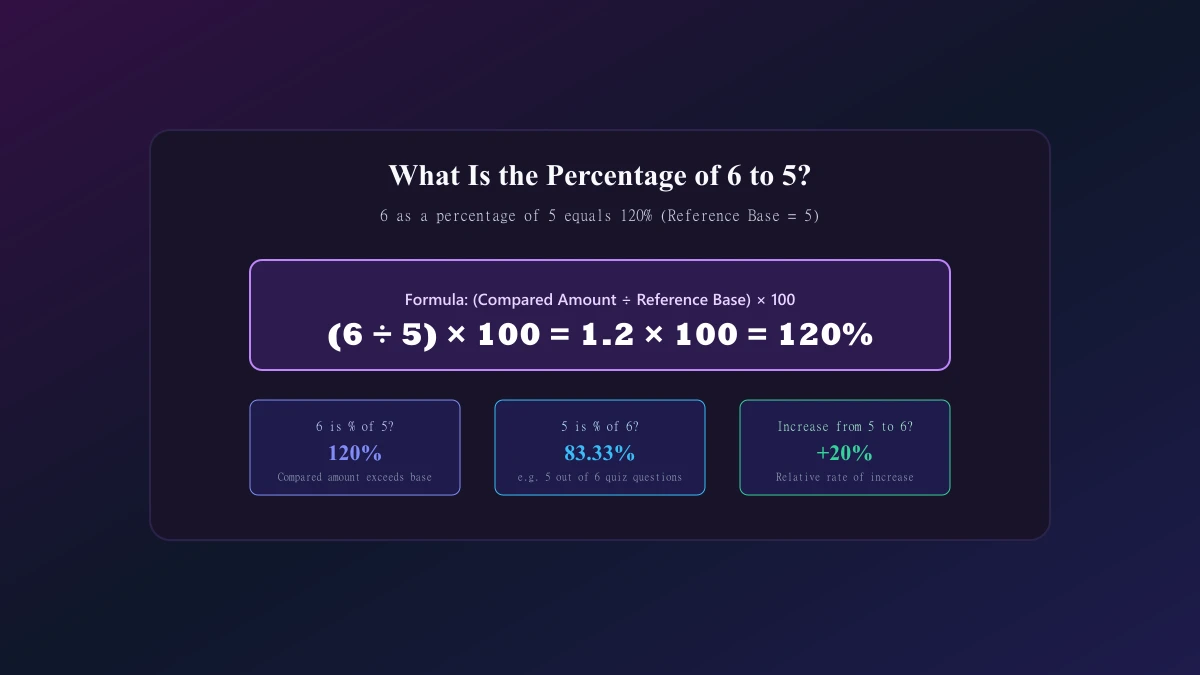
What Is the Percentage of 6 to 5? Answer With Easy Steps
Find out what is the percentage of 6 5 with clear steps and examples. Learn why the answer is 120%, how to reverse the calculation, and avoid common mistakes.
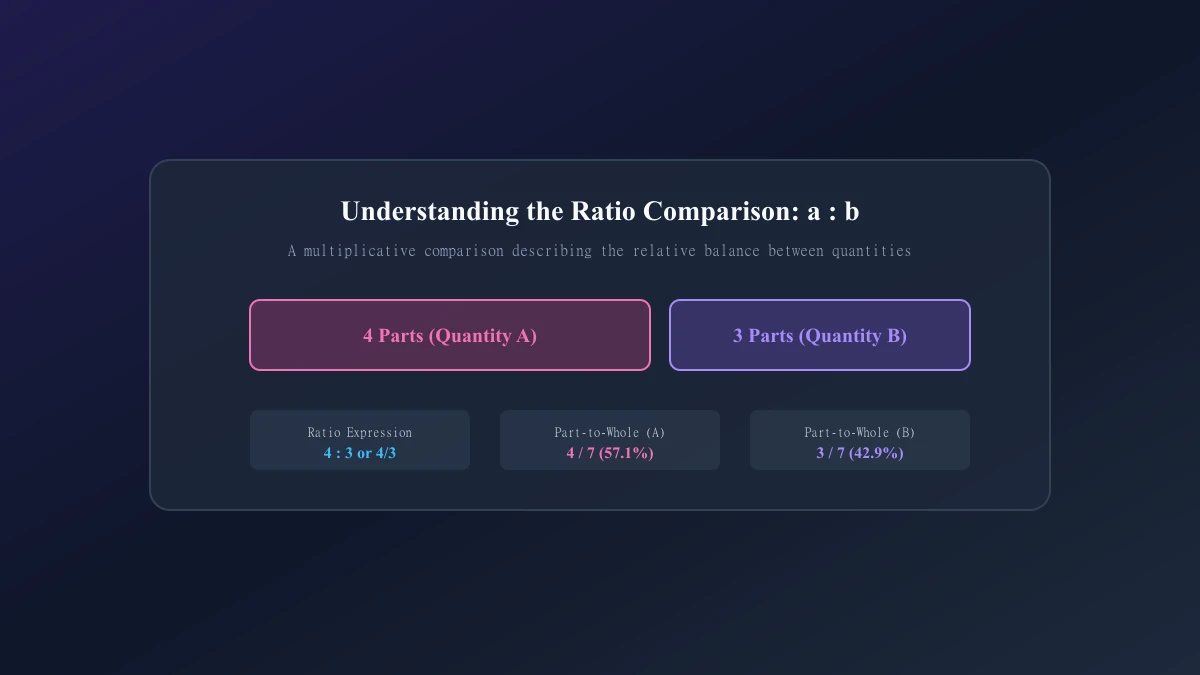
What Is a Ratio? Definition, Types, and Everyday Examples
Learn what is a ratio, how to read and write one, and how ratios differ from fractions, rates, and proportions, with everyday examples and practice questions.

Image Aspect Ratio Calculator: Find Dimensions and Resize Photos Correctly
Use an image aspect ratio calculator to find proportions, calculate width and height, and choose between resizing, cropping, or padding without distortion.