
What Is a Ratio? Definition, Types, and Everyday Examples
Learn what is a ratio, how to read and write one, and how ratios differ from fractions, rates, and proportions, with everyday examples and practice questions.
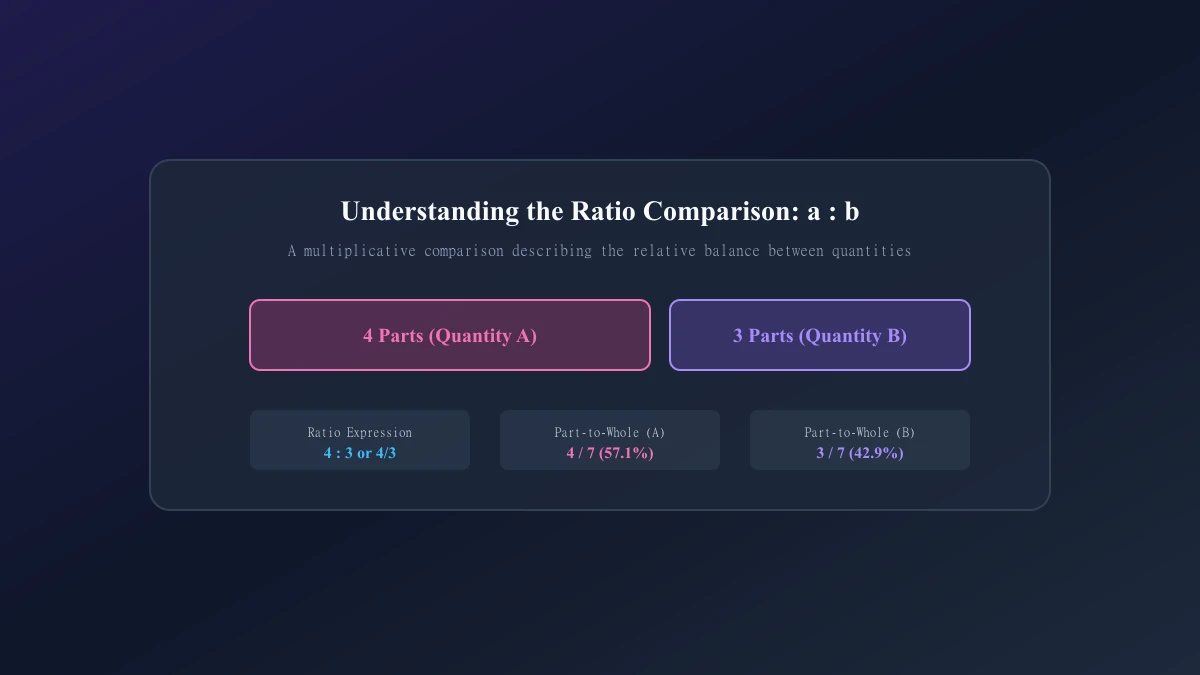
Table of Contents
- Quick Definition
- What Is a Ratio Telling You About the Quantities?
- How to Read and Write the Notation
- How to Write a Ratio in Three Ways
- Why Order Matters
- Types of Ratios: Parts, Wholes, and Multiple Categories
- Equivalent Ratios Describe the Same Balance
- Why “More Than” Is Different From “Times As Many”
- Ratio vs. Fraction, Rate, and Proportion
- Examples of Ratios in Everyday Life
- What a Ratio Cannot Tell You by Itself
- Frequently Asked Questions
- What does a 1:1 ratio mean?
- Can a ratio be greater than one?
- Do ratios have to use whole numbers?
- How do you turn a ratio into a percentage?
- Read the Relationship Before Doing the Arithmetic
If you are asking what is a ratio, start with this idea: it is a comparison of quantities that describes their relative amounts. A theater with eight occupied seats for every three empty seats has an occupied-to-empty ratio of 8:3. The numbers tell you how the two groups relate, even without knowing the theater’s total capacity.
That makes ratios useful for describing mixtures, collections, measurements, and patterns. They answer questions such as how much of one quantity there is compared with another, or what share of a collection belongs to a category.
The main challenge is understanding what each number represents. A comparison between occupied and empty seats is different from a comparison between occupied seats and all seats. Once you can name the quantities and read their relationship, the notation becomes much easier to understand.
Quick Definition
A ratio compares the relative amounts of two or more quantities. The ratio a:b means $a$ units of the first quantity for every $b$ units of the second. Its meaning depends on the order and labels. Ratios can compare separate parts, a part with a whole, or measurements of related quantities.
What Is a Ratio Telling You About the Quantities?
Think of a ratio as a description of a pattern rather than a complete inventory.
If a flower display uses carnations and lilies in a ratio of 4:3, one possible arrangement contains four carnations and three lilies. Another contains 20 carnations and 15 lilies. The sizes differ, but the flowers maintain the same relationship.
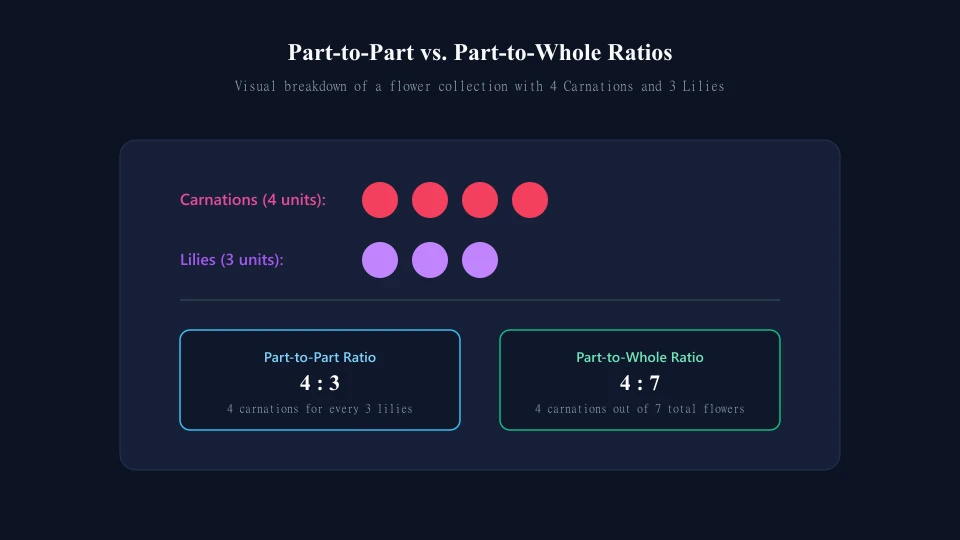
The ratio meaning can be expressed as “four carnations for every three lilies.” It does not say that there must be exactly seven flowers in the display.
This is a multiplicative comparison:
- The number of carnations is $\frac{4}{3}$ times the number of lilies.
- Reversing the viewpoint, lilies represent $\frac{3}{4}$ of carnations.
Neither fraction describes a flower type’s share of the combined display; that requires using the total count of flowers ($4 + 3 = 7$) as the reference denominator.
Always ask: “Compared with what?” That question is more useful than memorizing a ratio definition without its context.
How to Read and Write the Notation
Read 6:5 as “six to five,” or “six of the first quantity for every five of the second.”
How to Write a Ratio in Three Ways
A school exhibition contains six paintings and five sculptures:
- Using a colon:
6:5 - Using words:
6 to 5 - As a fraction:
6/5
In fraction notation, the first quantity becomes the numerator and the second becomes the denominator. The colon is simply a separator; it does not mean subtraction.
Why Order Matters
Paintings to sculptures is 6:5. Sculptures to paintings is 5:6. Both describe the exhibition correctly, but they answer different questions. Always state the labels clearly.
Types of Ratios: Parts, Wholes, and Multiple Categories
A community garden has 18 herb plants and 30 flowering plants (48 plants total).
| Comparison | Original Form | Simplified Form | Meaning |
|---|---|---|---|
| Herbs to flowering plants | 18:30 | 3:5 | Three herbs for every five flowering plants (part-to-part) |
| Herbs to all plants | 18:48 | 3:8 | Three herbs for every eight plants overall (part-to-whole) |
| All plants to herbs | 48:18 | 8:3 | Eight plants overall for every three herbs (whole-to-part) |
Ratios can also have more than two terms. A flag pattern using orange, purple, and white fabric in a 2:5:1 ratio has 8 combined parts. Orange accounts for $\frac{2}{8}$, purple for $\frac{5}{8}$, and white for $\frac{1}{8}$.
Equivalent Ratios Describe the Same Balance
Equivalent ratios preserve a relationship while changing the size of the quantities.
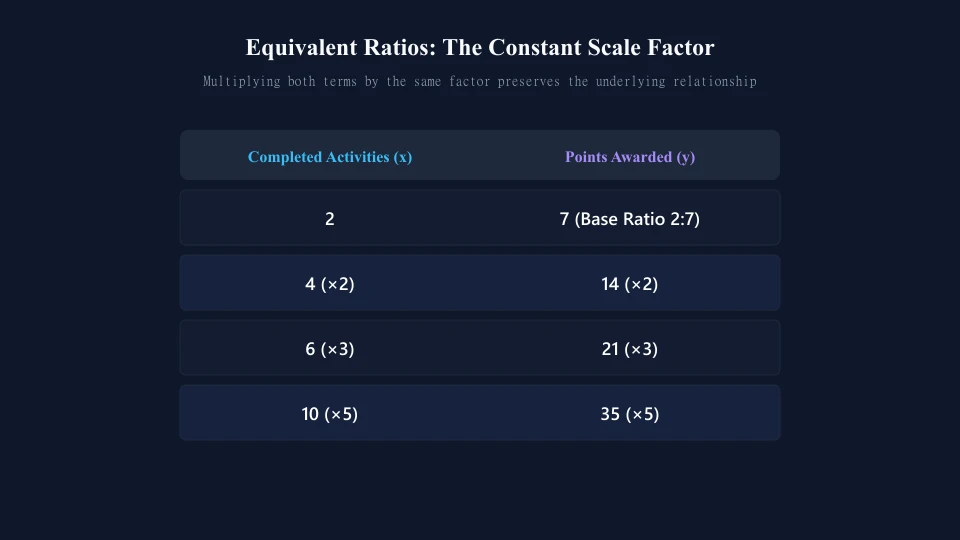
| Completed Activities | Points Awarded | Ratio ($x:y$) | Scale Multiplier |
|---|---|---|---|
| 2 | 7 | 2:7 | Base (×1) |
| 4 | 14 | 4:14 | ×2 |
| 6 | 21 | 6:21 | ×3 |
| 10 | 35 | 10:35 | ×5 |
Moving from 2:7 to 6:21 uses a scale factor of 3. Simplifying ratios reverses this process: dividing both terms of 16:28 by 4 gives 4:7.
Why “More Than” Is Different From “Times As Many”
Subtraction and ratios describe different features:
- Shelf A contains 12 books, and Shelf B contains 8. Shelf A has 4 more books (difference = 4), and its book count is 1.5 times Shelf B’s count (ratio = 3:2).
- Now compare 24 books with 20 books. The difference is still 4, but the ratio is now 6:5 (1.2 times as many).
Equal differences do not imply equal ratios. Use subtraction when the question asks how many more or fewer. Use a ratio when it asks how relative amounts compare.
Ratio vs. Fraction, Rate, and Proportion
- Ratio vs. Fraction: A ratio compares two quantities ($a:b$). A fraction representing that ratio ($a/b$) does not necessarily represent a share of the whole unless $b$ is the combined total.
- Ratio vs. Rate: In introductory math, a rate compares quantities with different units (e.g., 60 miles per hour). A unit rate normalizes the comparison to one unit of the second quantity.
- Ratio vs. Proportion: A ratio is a single comparison ($3:8$). A proportion is an equation stating that two ratios are equal ($3:8 = 9:24$).
Examples of Ratios in Everyday Life
- Parking Occupancy: A parking area with 27 occupied spaces and 9 vacant spaces has an occupied-to-vacant ratio of 3:1 (meaning $\frac{3}{4}$, or 75%, of spaces are occupied).
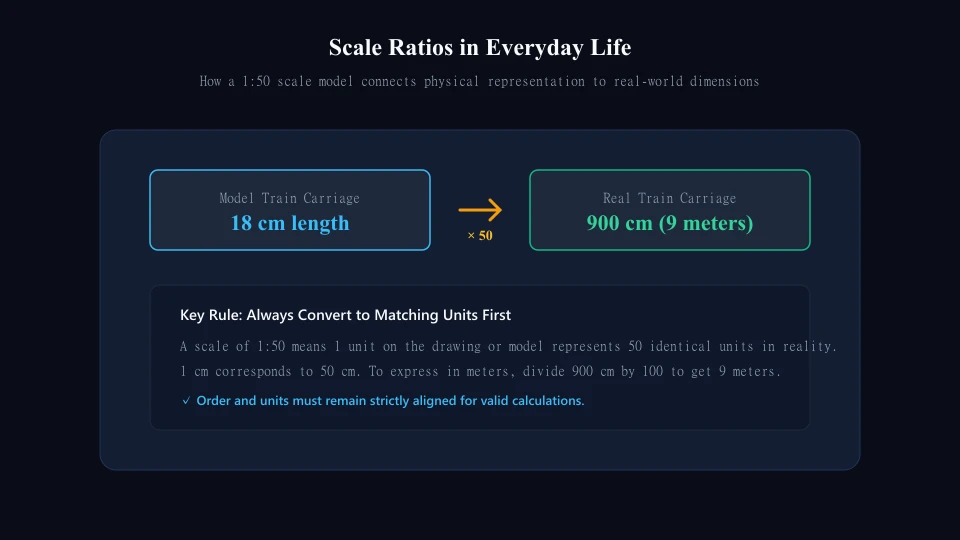
- Map and Model Scales: A model carriage with a 1:50 scale ratio means 1 cm on the model represents 50 cm (0.5 m) on the real vehicle. An 18 cm model corresponds to 900 cm (9 meters).
- Recipe Mixtures: A decorative sand blend containing 2 measures of gold sand for every 9 of white sand preserves its shade when doubled to 4 and 18 measures.
What a Ratio Cannot Tell You by Itself
- It does not reveal the total: A 5:2 relationship could describe 5 and 2, 50 and 20, or 500 and 200.
- It does not prove causation: A team completing twice as many tasks as another may simply have twice as many team members.
- It may summarize uneven situations: A school district student-to-teacher ratio of 18:1 does not mean every classroom has exactly 18 students.
Frequently Asked Questions
What does a 1:1 ratio mean?
A 1:1 ratio means the two quantities are equal. It does not necessarily mean one item of each—40 chairs and 40 desks also form a 1:1 ratio.
Can a ratio be greater than one?
Yes. When a ratio is expressed as a quotient, its value exceeds 1 whenever the first positive term is larger than the second (e.g., $11:4 = 2.75$).
Do ratios have to use whole numbers?
No. Ratios can contain decimals or fractions (such as $0.6 : 1.4 = 3 : 7$). Whole numbers are simply the most common and readable format.
How do you turn a ratio into a percentage?
Identify the reference quantity. For $A:B = 7:3$, $A$ is $\frac{7}{3} \times 100% \approx 233.3%$ of $B$. As a share of the combined total, $A$ represents $\frac{7}{10} \times 100% = 70%$.
Read the Relationship Before Doing the Arithmetic
A ratio is a comparison with clear labels and a clear reference base. Identify what comes first, what comes second, and whether either number represents a total. Understanding that meaning gives you a solid foundation for solving any math or real-world problem.
BigTechies Editorial Team
The Ratio Solver editorial team specializes in clear, step-by-step mathematical guides, statistical analysis explanations, and practical calculation workflows for students, educators, and professionals.
Solve Any Ratio in Seconds With Our Free Calculator
Simplify whole numbers, fractions, and decimals, find missing values, or divide totals in proportional parts with verified instant accuracy.
Related Articles
Continue exploring practical calculation guides and tutorials
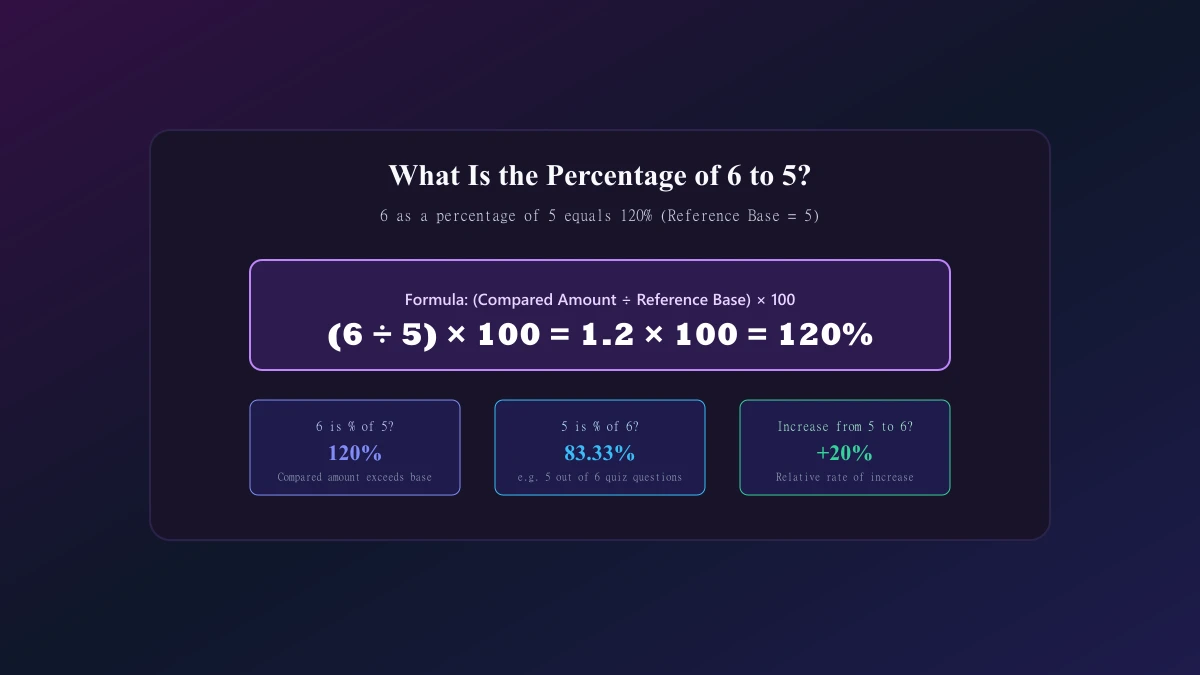
What Is the Percentage of 6 to 5? Answer With Easy Steps
Find out what is the percentage of 6 5 with clear steps and examples. Learn why the answer is 120%, how to reverse the calculation, and avoid common mistakes.
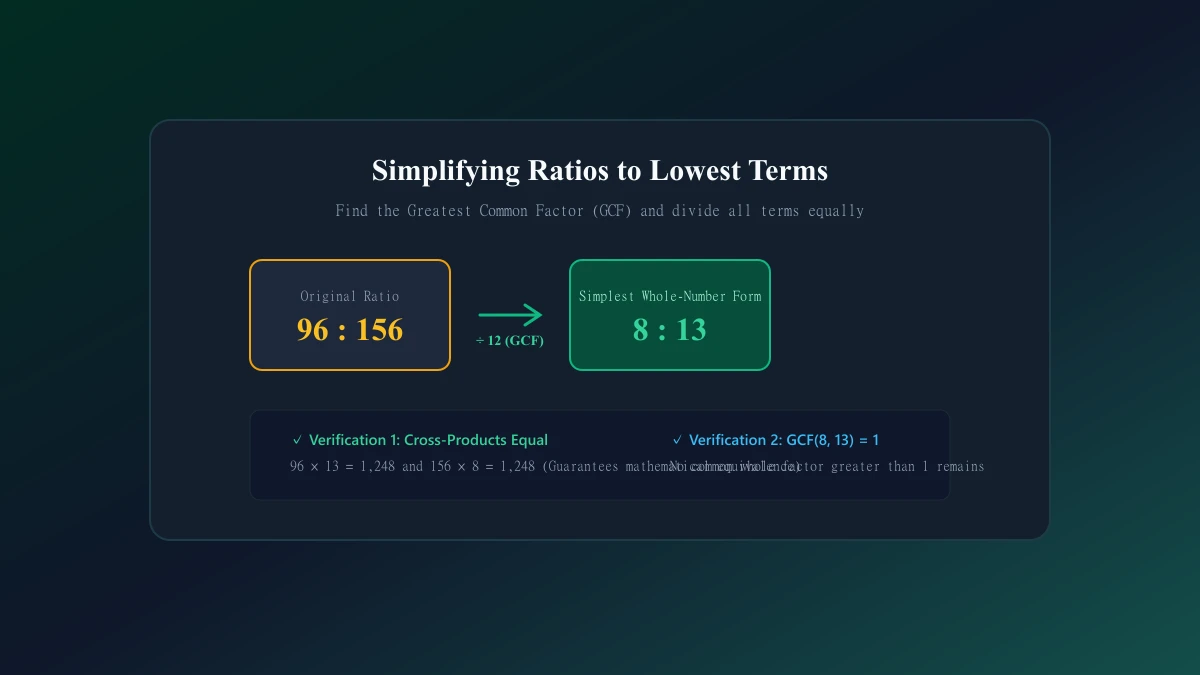
Ratio Simplifier: Reduce Ratios to Their Simplest Form
Use a ratio simplifier to reduce whole numbers, decimals, fractions, and three-part ratios. Learn GCF methods, check your answers, and avoid common mistakes.

Image Aspect Ratio Calculator: Find Dimensions and Resize Photos Correctly
Use an image aspect ratio calculator to find proportions, calculate width and height, and choose between resizing, cropping, or padding without distortion.