
What Is the Percentage of 6 to 5? Answer With Easy Steps
Find out what is the percentage of 6 5 with clear steps and examples. Learn why the answer is 120%, how to reverse the calculation, and avoid common mistakes.
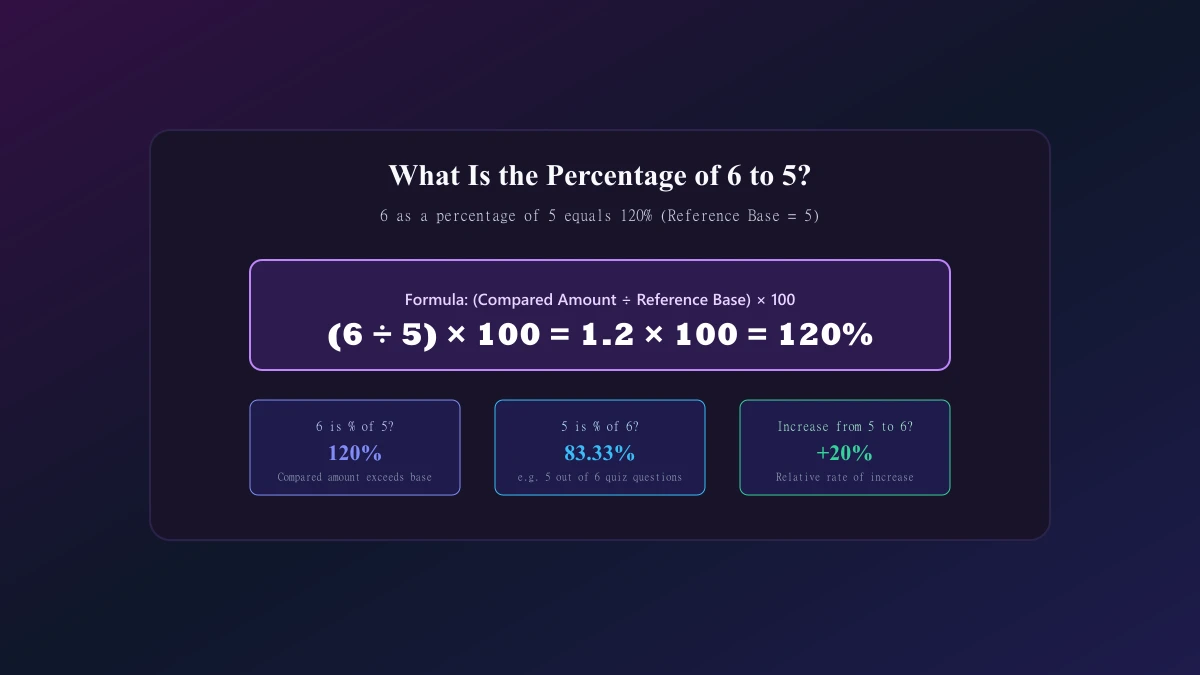
Table of Contents
- Quick Answer: 6 Is 120% of 5
- What Does “What Is the Percentage of 6 5” Mean?
- How to Calculate 6 as a Percentage of 5
- Method 1: Divide, Then Multiply
- Method 2: Scale the Denominator to 100
- Method 3: Mental Math
- Why Can the Answer Be More Than 100%?
- What If You Mean 5 Out of 6 as a Percentage?
- Percentage Comparison vs. Percentage Change
- How to Convert a Ratio of 6:5 Into Percentages
- Frequently Asked Questions
- Why is 6 out of 5 more than 100 percent?
- Is 6 divided by 5 equal to 1.2%?
- What if I meant the decimal 6.5?
- Can the reference value ever be zero?
- Choose the Base Before You Calculate
If you are asking “what is the percentage of 6 5” and mean 6 as a percentage of 5, the answer is 120%. Divide 6 by 5, then multiply the result by 100. The number 5 is your reference value, so it represents 100% in this comparison.
The wording matters, though. If you mean five correct answers out of six questions, your percentage is about 83.33%. If you mean an increase from 5 to 6, the answer is 20%. Those results use the same numbers but answer different questions.
This guide explains the main calculation, shows a quick mental method, and helps you choose the right formula. You will also learn when percentages above 100% make sense, how to read a ratio of 6:5, and how to check your answer before using it in homework or an everyday comparison.
Quick Answer: 6 Is 120% of 5
Use this percentage formula:
$$\text{Percentage} = \left(\frac{\text{Compared Amount}}{\text{Reference Value}}\right) \times 100$$
For this question:
$$\left(\frac{6}{5}\right) \times 100 = 1.2 \times 100 = 120%$$
This tells you that 6 is 1.2 times as large as 5. Another way to say it is that 6 equals all of 5 (100%), plus an additional one-fifth of 5 (20%). The answer is exactly 120%; no rounding is needed.
What Does “What Is the Percentage of 6 5” Mean?
Without punctuation or operational symbols, the phrase leaves the exact relationship ambiguous:
| Intended Question | Calculation | Answer | Meaning |
|---|---|---|---|
| 6 is what percent of 5? | $(6 \div 5) \times 100$ | 120% | Compared amount exceeds base value |
| 5 is what percent of 6? | $(5 \div 6) \times 100$ | $\approx 83.33%$ | e.g. 5 correct answers out of 6 |
| What is 6% of 5? | $0.06 \times 5$ | 0.3 | Absolute value (not a percentage) |
| What is 5% of 6? | $0.05 \times 6$ | 0.3 | Absolute value |
| What is the increase from 5 to 6? | $\frac{6 - 5}{5} \times 100$ | 20% | Relative percentage increase |
| What is the decrease from 6 to 5? | $\frac{6 - 5}{6} \times 100$ | $\approx 16.67%$ | Relative percentage decrease |
Notice that “what percent” asks for a percentage, while “6% of 5” asks for an amount (0.3).
How to Calculate 6 as a Percentage of 5
Method 1: Divide, Then Multiply
- Write the comparison as a fraction: $\frac{6}{5}$
- Divide numerator by denominator: $6 \div 5 = 1.2$
- Convert decimal to percentage: $1.2 \times 100 = \mathbf{120%}$
Method 2: Scale the Denominator to 100
Since $5 \times 20 = 100$, multiply both numerator and denominator by 20:
$$\frac{6}{5} = \frac{6 \times 20}{5 \times 20} = \frac{120}{100} = \mathbf{120%}$$
Method 3: Mental Math
If 5 represents 100%, each unit represents $100% \div 5 = 20%$. Six units represent:
$$6 \times 20% = \mathbf{120%}$$
Why Can the Answer Be More Than 100%?
A percentage above 100% means the compared amount is greater than the reference baseline. It does not indicate an error.
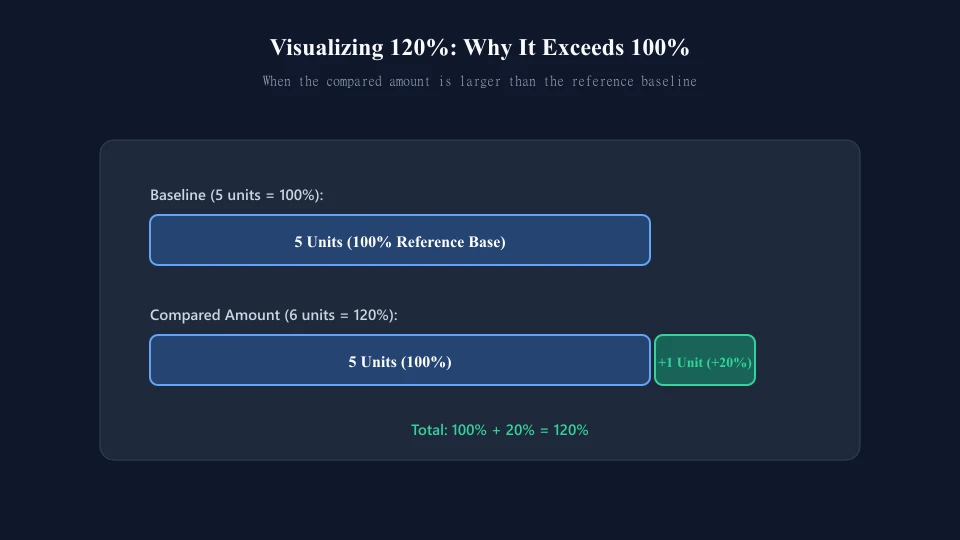
Suppose your daily reading goal is 5 pages, but you read 6 pages. You achieved 120% of your goal.
Key guidelines:
- A comparison against a target or benchmark can exceed 100%.
- A subset of a fixed whole cannot exceed that whole.
- A standard test score can exceed 100% only if bonus credit is awarded.
The fraction $\frac{6}{5}$ is an improper fraction ($> 1$), which naturally converts to a percentage greater than 100%.
What If You Mean 5 Out of 6 as a Percentage?
If five items belong to a group containing six items:
$$\left(\frac{5}{6}\right) \times 100 = 83.333\dots% \approx \mathbf{83.33%}$$
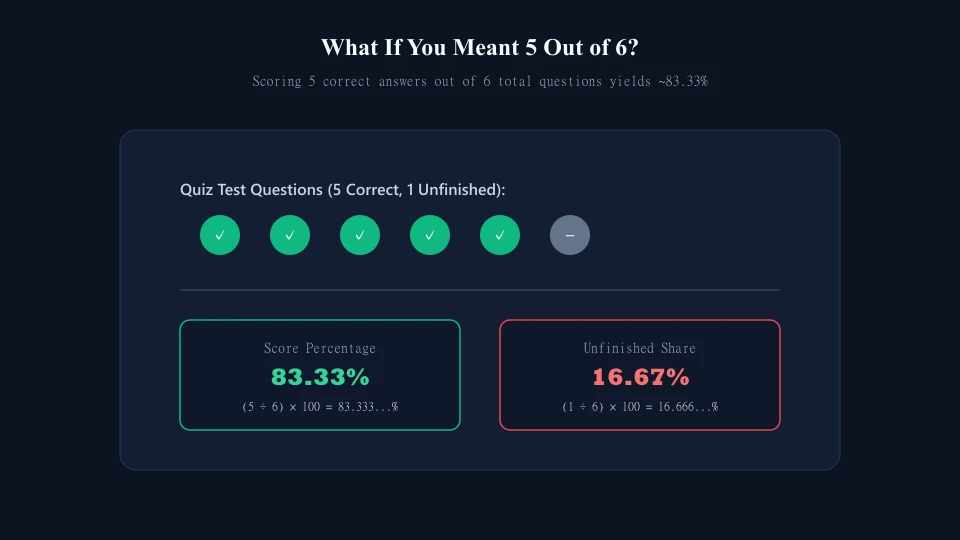
Here, 6 is the entire whole and belongs in the denominator. When the compared amount is smaller than the positive baseline, the result must fall below 100%.
Percentage Comparison vs. Percentage Change
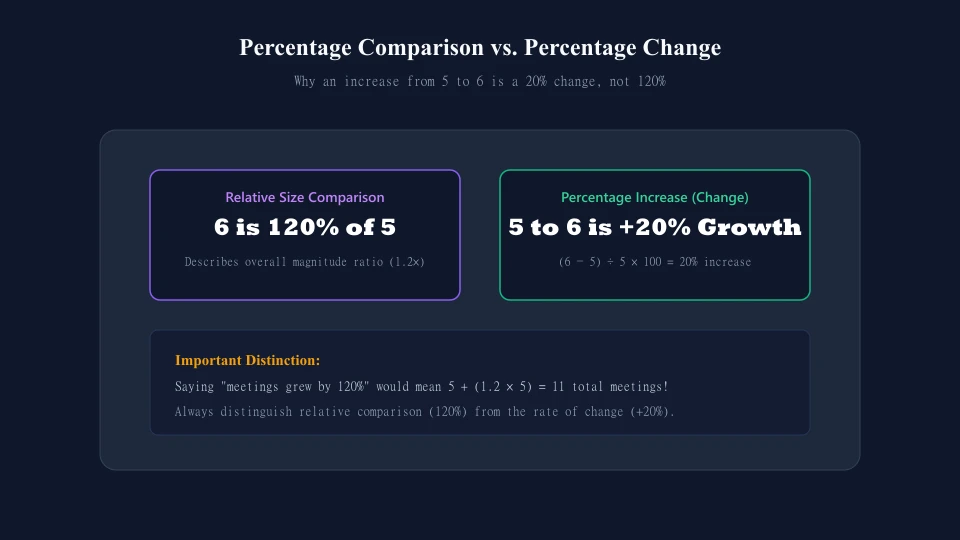
- Percentage Comparison (Magnitude): Describes how large one number is relative to another. $6 \div 5 \times 100 = \mathbf{120%}$.
- Percentage Increase (Change): $$\text{Percentage Increase} = \frac{\text{New} - \text{Original}}{\text{Original}} \times 100 = \frac{6 - 5}{5} \times 100 = \mathbf{20%}$$ Saying a club meeting attendance “grew by 120%” would mean adding 6 new meetings to the original 5, resulting in 11 meetings!
How to Convert a Ratio of 6:5 Into Percentages
A ratio of 6:5 describes two parts of an 11-part combined group (e.g., 6 green counters and 5 yellow counters):
- Green share: $\frac{6}{6 + 5} \times 100 = \frac{6}{11} \times 100 \approx \mathbf{54.55%}$
- Yellow share: $\frac{5}{6 + 5} \times 100 = \frac{5}{11} \times 100 \approx \mathbf{45.45%}$
Together they total 100%. By contrast, the direct part-to-part ratio compares green against yellow ($\frac{6}{5} \times 100 = 120%$).
Frequently Asked Questions
Why is 6 out of 5 more than 100 percent?
Because 5 represents 100% of the baseline, while 6 is larger. The extra 1 unit contributes an additional 20%.
Is 6 divided by 5 equal to 1.2%?
No! Six divided by 5 equals the decimal 1.2, which is 120%. The value 1.2% equals 0.012 as a decimal.
What if I meant the decimal 6.5?
The decimal 6.5 converted to a percentage is 650% ($6.5 \times 100$). If you meant 6.5%, that is already a percentage and equals 0.065.
Can the reference value ever be zero?
No. Standard percentage formulas cannot divide by zero ($\frac{6}{0}$ is mathematically undefined).
Choose the Base Before You Calculate
The answer to “what is the percentage of 6 5” is 120% when you mean 6 as a percentage of 5. Divide the compared amount by the reference base, then multiply by 100.
BigTechies Editorial Team
The Ratio Solver editorial team specializes in clear, step-by-step mathematical guides, statistical analysis explanations, and practical calculation workflows for students, educators, and professionals.
Solve Any Ratio in Seconds With Our Free Calculator
Simplify whole numbers, fractions, and decimals, find missing values, or divide totals in proportional parts with verified instant accuracy.
Related Articles
Continue exploring practical calculation guides and tutorials
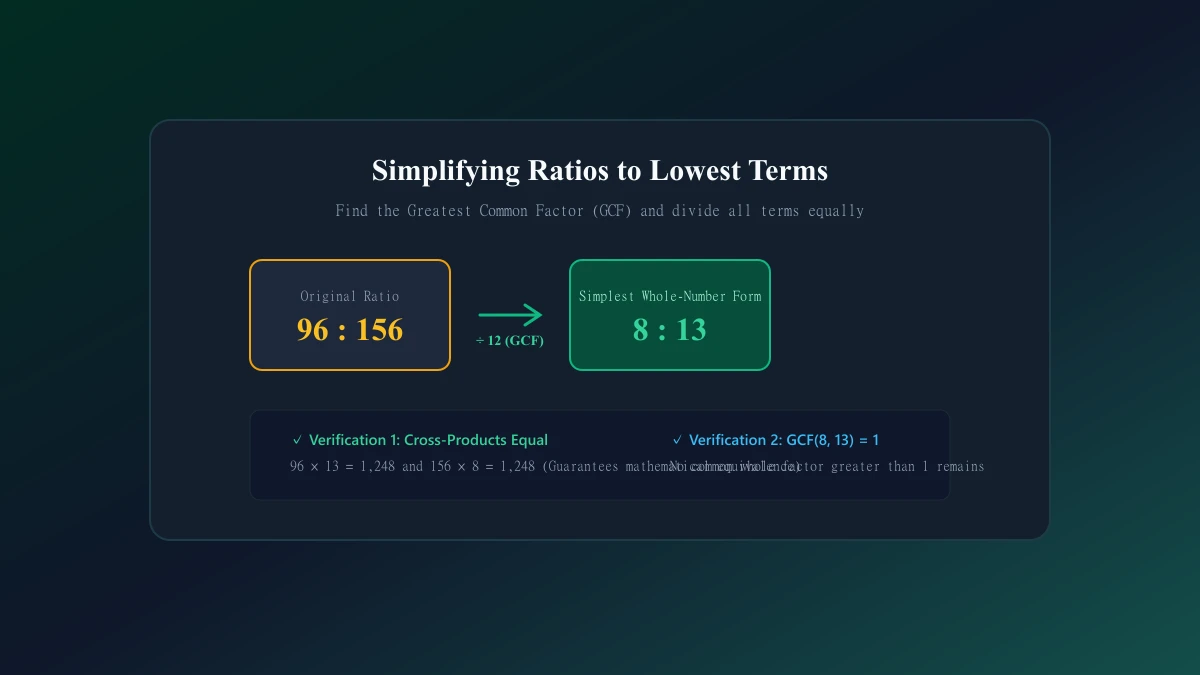
Ratio Simplifier: Reduce Ratios to Their Simplest Form
Use a ratio simplifier to reduce whole numbers, decimals, fractions, and three-part ratios. Learn GCF methods, check your answers, and avoid common mistakes.
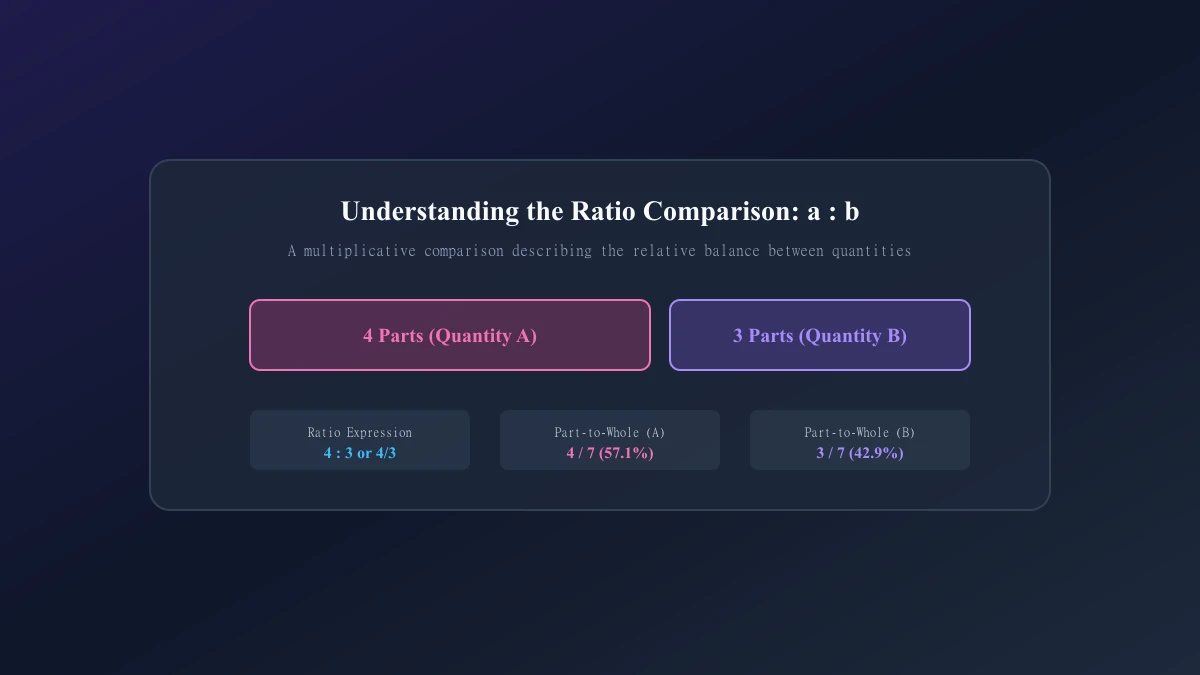
What Is a Ratio? Definition, Types, and Everyday Examples
Learn what is a ratio, how to read and write one, and how ratios differ from fractions, rates, and proportions, with everyday examples and practice questions.

Image Aspect Ratio Calculator: Find Dimensions and Resize Photos Correctly
Use an image aspect ratio calculator to find proportions, calculate width and height, and choose between resizing, cropping, or padding without distortion.