
How to Figure Out Ratios: Step-by-Step Guide With Examples
Learn how to figure out ratios with simple steps, worked examples, and practical tips for comparing quantities, splitting totals, and checking your answers.

Table of Contents
- Quick Answer
- Read the Comparison Before Doing the Math
- How to Figure Out Ratios in Four Steps
- 1. Identify and Label the Quantities
- 2. Put the Numbers in the Requested Order
- 3. Find the Greatest Common Factor
- 4. Divide Both Terms and Interpret the Answer
- Choose the Formula That Matches the Question
- Worked Examples: Units, Totals, and Scaling
- Compare Quantities With Different Units
- Divide a Total in a Given Ratio
- Scale a Recipe From One Known Amount
- Handle Decimals, Fractions, and Three Quantities
- Decimal Quantities
- Fractional Quantities
- Ratios With Three Numbers
- Check Equivalent Ratios Without Guessing
- Avoid Mistakes That Change the Relationship
- Practice Finding Ratios From Different Clues
- Frequently Asked Questions
- How do you find a ratio when the numbers have no common factor?
- How do you express a ratio as 1:n?
- How can you find a ratio from percentages?
- Can you figure out a ratio from the total alone?
- How can you use a ratio calculator to check your work?
- Is a ratio the same as a proportion?
- Start With the Labels, Then Calculate
Learning how to figure out ratios starts with identifying exactly what you are comparing. Write the quantities in the requested order, convert matching measurements into the same units, and divide both numbers by their greatest common factor. For example, 18 red counters and 12 blue counters give a red-to-blue ratio of 18:12, which simplifies to 3:2.
The arithmetic is usually short. The harder part is deciding what the numbers represent. Comparing red counters with blue counters produces a different answer from comparing red counters with all the counters combined.
Some questions also give you a ratio and ask you to work backward. You might need to divide a total between two people, scale a recipe, or find a missing quantity. Each task uses the same relationship between amounts, but the starting information determines which calculation you need.
Quick Answer
To calculate a ratio, identify the quantities and put them in the requested order. Convert measurements of the same kind into matching units. Write the comparison as a:b, then divide both terms by their greatest common factor (GCF) to express a whole-number ratio in simplest form. Keep each quantity clearly labeled.
Read the Comparison Before Doing the Math
A ratio describes the relative amounts of two or more quantities. The expression 3:2 means three units of the first quantity for every two units of the second.
You can write a two-part ratio in three common ways:
- Using a colon:
3:2 - Using words:
3 to 2 - As a fraction:
3/2
These forms describe the same comparison when the labels stay consistent. However, the fraction does not automatically describe a share of the total.
Return to the counters: there are 18 red, 12 blue, and 30 altogether.
| Requested Comparison | Original Ratio | Simplest Form |
|---|---|---|
| Red to blue | 18:12 | 3:2 |
| Blue to red | 12:18 | 2:3 |
| Red to all counters | 18:30 | 3:5 |
The first comparison is part-to-part. The last is part-to-whole. Read the wording carefully before choosing your numbers. “Red to blue” and “red out of the total” answer different questions, even though they describe the same collection.
How to Figure Out Ratios in Four Steps
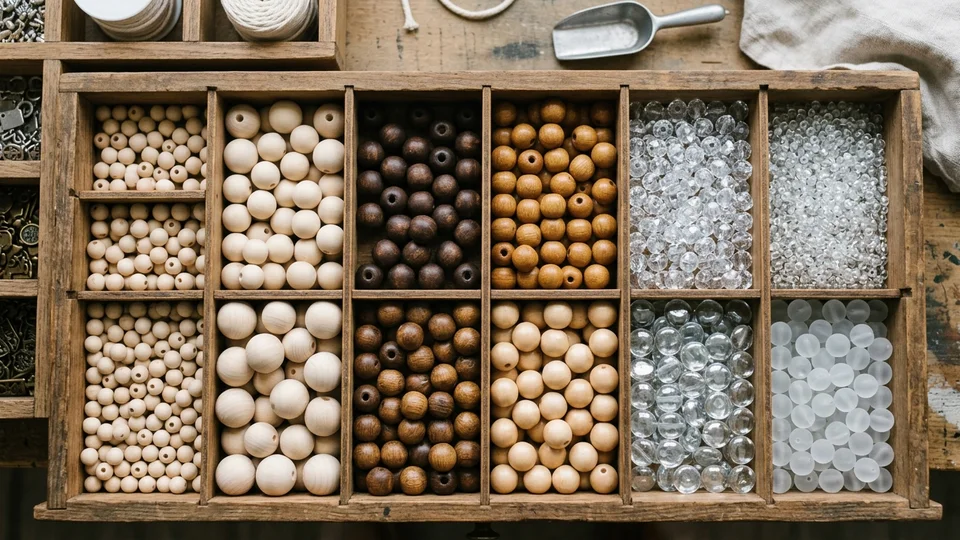
Consider a craft drawer containing 28 wooden beads and 42 glass beads. You need the ratio of wooden beads to glass beads.
1. Identify and Label the Quantities
Write down what each number measures:
- Wooden beads = 28
- Glass beads = 42
Both quantities count individual beads, so no unit conversion is needed. Labels are especially helpful in ratio word problems because a question may also mention an unrelated number, such as the number of storage boxes.
2. Put the Numbers in the Requested Order
The question asks for wooden beads first and glass beads second:
$$\text{Wooden} : \text{Glass} = 28 : 42$$
Do not automatically put the smaller number first. The order follows the question, regardless of which quantity is larger.
3. Find the Greatest Common Factor
The greatest common factor, or GCF, is the largest whole number that divides both values without a remainder. It is also called the highest common factor (HCF).
- The factors of 28 are: 1, 2, 4, 7, 14, and 28.
- The factors of 42 are: 1, 2, 3, 6, 7, 14, 21, and 42.
Their largest shared factor is 14.
4. Divide Both Terms and Interpret the Answer
- $28 \div 14 = 2$
- $42 \div 14 = 3$
Therefore, 28:42 = 2:3.
There are two wooden beads for every three glass beads. This does not mean the drawer contains only five beads. It means the collection can be organized into 14 equal groups, each containing two wooden beads and three glass beads.
If you cannot spot the GCF immediately, divide by smaller common factors in stages. Dividing 28:42 by 2 gives 14:21. Dividing both new terms by 7 then gives 2:3.
Choose the Formula That Matches the Question
There is no single ratio formula that answers every type of problem. First decide whether you are comparing known quantities, scaling an existing relationship, or distributing a total.
| Starting Information | Required Result | Calculation |
|---|---|---|
| Two whole-number quantities $a$ and $b$ | Simplest ratio | $(a \div g):(b \div g)$, where $g$ is their GCF |
| Ratio $a:b$ and a new first quantity $A$ | Matching second quantity $B$ | $B = A \times \frac{b}{a}$ |
| Total $T$ split into two shares $a:b$ | Each share | $\text{First} = T \times \frac{a}{a+b}$; $\text{Second} = T \times \frac{b}{a+b}$ |
The scaling formula assumes $a$ is nonzero. For sharing problems, $a$ and $b$ represent positive shares that together account for the entire total.
Dividing $a$ by $b$ gives a quotient, which can be useful for comparison. But a decimal such as 1.5 may not be the form the question requests. If you need a simplest whole-number ratio, 3:2 communicates that result directly.
Worked Examples: Units, Totals, and Scaling
Knowing how to calculate ratios becomes more useful when you can recognize which method fits the information provided.
Compare Quantities With Different Units
A ribbon design uses 1.2 meters of green ribbon and 80 centimeters of white ribbon. Find the green-to-white ratio.

You cannot compare the written numbers 1.2 and 80 directly because their units differ. Convert meters to centimeters first:
$$1.2\text{ meters} = 120\text{ centimeters}$$
Now write and simplify the ratio:
$$120 : 80 = 3 : 2$$
For every three equal lengths of green ribbon, the design uses two of white. Converting both lengths to meters would produce the same relationship, but centimeters make the whole-number calculation easier.
Divide a Total in a Given Ratio
Two volunteers share 72 seed packets in a ratio of 5:3. How many packets should each receive?
- Add the ratio terms: $5 + 3 = 8\text{ total parts}$
- Find the value of one part: $72 \div 8 = 9\text{ packets}$
- Multiply by each person’s number of parts:
- First volunteer: $5 \times 9 = 45\text{ packets}$
- Second volunteer: $3 \times 9 = 27\text{ packets}$
Check both requirements: $45 + 27 = 72$, and $45:27$ simplifies to $5:3$. Dividing the total by 5 or by 3 would not work. The total represents all eight parts together, not either person’s share alone.
Scale a Recipe From One Known Amount
A trail mix uses four scoops of cereal for every three scoops of dried fruit. If you use 20 scoops of cereal, how much dried fruit maintains the recipe’s ratio?
- Find the scale factor (the multiplier): $20 \div 4 = 5$
- Apply that multiplier to the dried fruit: $3 \times 5 = 15\text{ scoops}$
The new ratio is 20:15, equivalent to 4:3. This example assumes the same scoop measure throughout. The method preserves the ingredient amounts by volume; it does not imply that a scoop of each ingredient weighs the same.
Handle Decimals, Fractions, and Three Quantities
Ratios can contain decimals or fractions. When simplest whole-number form is required, remove those features by multiplying every term by the same suitable value.

Decimal Quantities
Find the ratio of 1.5 liters to 2.25 liters.
- Multiply both values by 100 to clear the decimal places: $1.5 : 2.25 = 150 : 225$
- Divide both terms by 75: $150 : 225 = 2 : 3$
The multiplier depends on the number of decimal places present. Here, multiplying by 10 would leave 15:22.5, which is equivalent but still contains a decimal.
Fractional Quantities
Compare $\frac{3}{4}$ cup with $\frac{1}{2}$ cup.
The least common multiple (LCM) of the denominators 4 and 2 is 4. Multiply each quantity by 4:
$$\left(\frac{3}{4} \times 4\right) : \left(\frac{1}{2} \times 4\right) = 3 : 2$$
Using a common denominator makes the comparison visible: three quarters of a cup compared with two quarters gives three to two. Do not compare the numerators until the fractions refer to equal-sized parts.
Ratios With Three Numbers
A mosaic contains 12 black tiles, 18 white tiles, and 30 gray tiles. The ratio is:
$$12 : 18 : 30$$
The greatest common factor of all three terms is 6. Dividing every term by 6 gives:
$$2 : 3 : 5$$
All three values must change together. Simplifying only the first two terms would alter their relationship with the third. Also, 2:3:5 contains ten total parts, so black tiles account for $\frac{2}{10}$ (or 20%) of the collection.
Check Equivalent Ratios Without Guessing
Equivalent ratios describe the same relationship at different scales. For example, 4:7, 8:14, and 20:35 all preserve the same relative amounts.
A ratio table makes the matching multipliers easy to see:
| Number of Groups | First Quantity | Second Quantity |
|---|---|---|
| 1 | 4 | 7 |
| 2 | 8 | 14 |
| 5 | 20 | 35 |
To check whether 12:21 matches 4:7, simplify 12:21 by dividing both terms by 3. You get 4:7, so the ratios are equivalent.
You can also compare cross-products. For $a:b$ and $c:d$, with nonzero second terms, equality requires:
$$a \times d = b \times c$$
Here, $12 \times 7 = 84$ and $21 \times 4 = 84$. Since both cross-products match, the equivalence is guaranteed.
Avoid Mistakes That Change the Relationship
Most errors happen before the final division. Learning how to work out ratios includes checking the setup, not just the arithmetic:
- Using addition to scale: Adding 3 to both terms of 2:5 gives 5:8, which is a completely different relationship. Equivalent ratios come strictly from multiplying or dividing every term by the same nonzero factor.
- Changing only one quantity: Halving the first term of 10:16 without halving the second produces the wrong comparison. Apply each scaling operation to all terms.
- Treating the second term as the total: In a red-to-blue ratio of 3:2, red represents three of five combined parts, not three of two total parts.
- Rounding indivisible objects: Suppose 10 chairs must be split in a ratio of 2:1. One part would be $\frac{10}{3}$ chairs, so an exact whole-chair split is impossible. Rounding the shares changes the ratio. Explain that limitation instead of presenting rounded counts as exact.
- Dropping the labels: An answer of 5:4 is incomplete if the reader cannot tell which quantity comes first. Keep the labels beside the ratio, especially when reversing the comparison is plausible.
Practice Finding Ratios From Different Clues
Try these questions before reading the answers. Each uses a different starting point:
- A class has 16 students traveling by bus and 12 walking. What is the ratio of walkers to all students?
- Answer: There are 28 students altogether. The requested comparison is 12:28, which simplifies to 3:7. The bus count helps find the total; it is not the second term by itself.
- Divide 96 stickers between two teams in a ratio of 7:5.
- Answer: The ratio contains 12 total parts. Each part equals $96 \div 12 = 8$ stickers. The teams receive 56 and 40 stickers. Both the sum ($56 + 40 = 96$) and the simplified comparison ($56:40 = 7:5$) match the question.
- A pattern uses five silver beads for every eight blue beads. How many blue beads are needed with 35 silver beads?
- Answer: The scale factor is $35 \div 5 = 7$. Multiply the blue quantity by the same factor: $8 \times 7 =$ 56 blue beads.
Frequently Asked Questions
How do you find a ratio when the numbers have no common factor?
If two positive whole numbers share no factor greater than 1, their ratio is already in simplest form. For example, 7:11 cannot be reduced further using whole numbers. You do not need to make either term equal to 1 unless the question specifically requests that format.
How do you express a ratio as 1:n?
Divide both terms by the first term, provided it is nonzero. For example, 8:20 becomes 1:2.5 because $8 \div 8 = 1$ and $20 \div 8 = 2.5$. This form tells you how much of the second quantity corresponds to one unit of the first.
How can you find a ratio from percentages?
If two percentages describe shares of the same total, write them as a ratio and simplify. A collection that is 35% red and 65% blue has a red-to-blue ratio of 35:65, or 7:13. Percentages from different totals cannot generally be compared this way to obtain a ratio of actual counts.
Can you figure out a ratio from the total alone?
No. A total does not reveal how it is divided. Twenty objects could be split 10 and 10, 8 and 12, or several other ways, producing different ratios. You need another piece of information, such as one quantity, a percentage share, or the relationship between the two parts.
How can you use a ratio calculator to check your work?
A ratio calculator can simplify known quantities or find a missing value, depending on the tool. Enter values in the correct order and convert matching measurements to consistent units first. Compare the output with your labeled setup. The calculator cannot determine whether you intended a part-to-part or part-to-whole comparison.
Is a ratio the same as a proportion?
A ratio compares quantities, such as 2:3. A proportion is an equation stating that two ratios are equal, such as $2/3 = 8/12$. Understanding that distinction helps when finding an unknown value: you can set up equivalent comparisons, keep their order consistent, and solve for the missing quantity.
Start With the Labels, Then Calculate
Knowing how to figure out ratios means choosing the right comparison before choosing an operation. Label the amounts, check their units, and decide whether you are simplifying known quantities, scaling a relationship, or splitting a total. After calculating, read the answer as a “for every” statement. If that statement matches the original question and the quantities check out, your result is ready to use.
BigTechies Editorial Team
The Ratio Solver editorial team specializes in clear, step-by-step mathematical guides, statistical analysis explanations, and practical calculation workflows for students, educators, and professionals.
Solve Any Ratio in Seconds With Our Free Calculator
Simplify whole numbers, fractions, and decimals, find missing values, or divide totals in proportional parts with verified instant accuracy.
Related Articles
Continue exploring practical calculation guides and tutorials
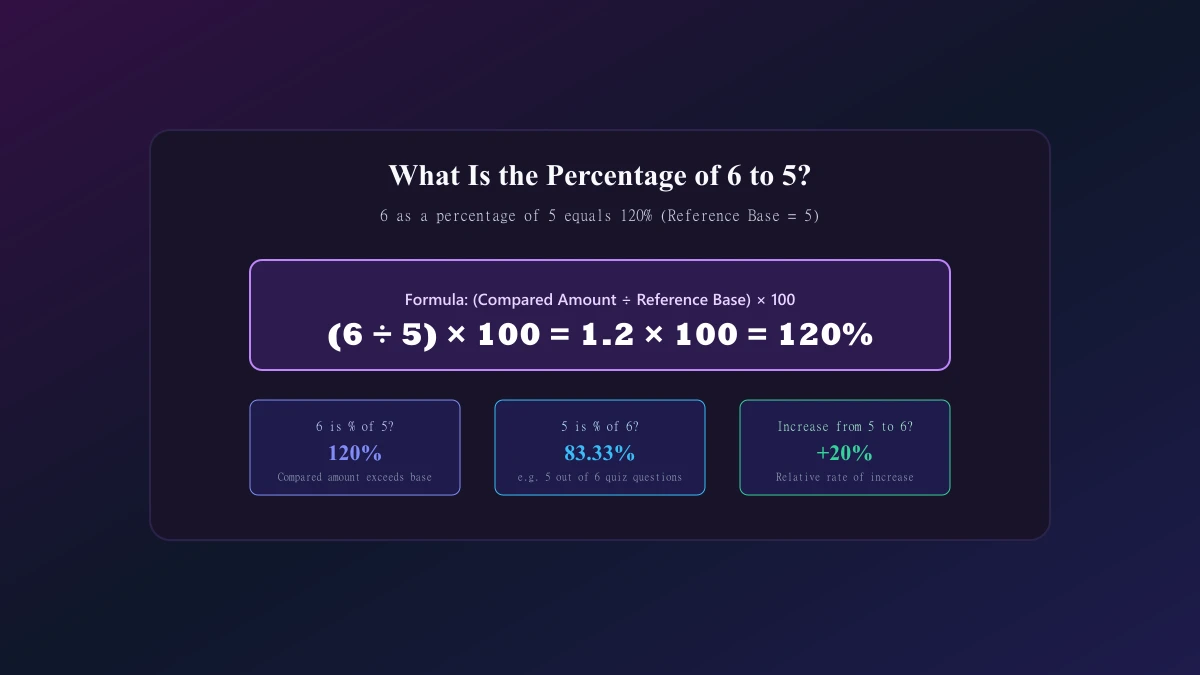
What Is the Percentage of 6 to 5? Answer With Easy Steps
Find out what is the percentage of 6 5 with clear steps and examples. Learn why the answer is 120%, how to reverse the calculation, and avoid common mistakes.
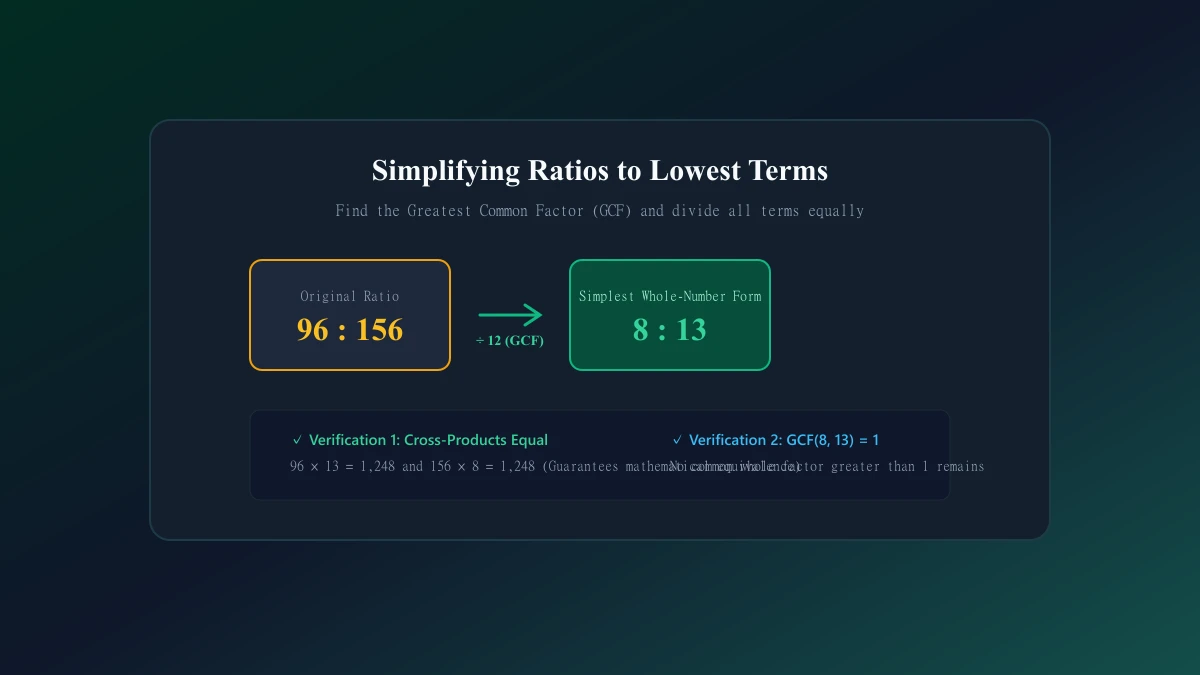
Ratio Simplifier: Reduce Ratios to Their Simplest Form
Use a ratio simplifier to reduce whole numbers, decimals, fractions, and three-part ratios. Learn GCF methods, check your answers, and avoid common mistakes.
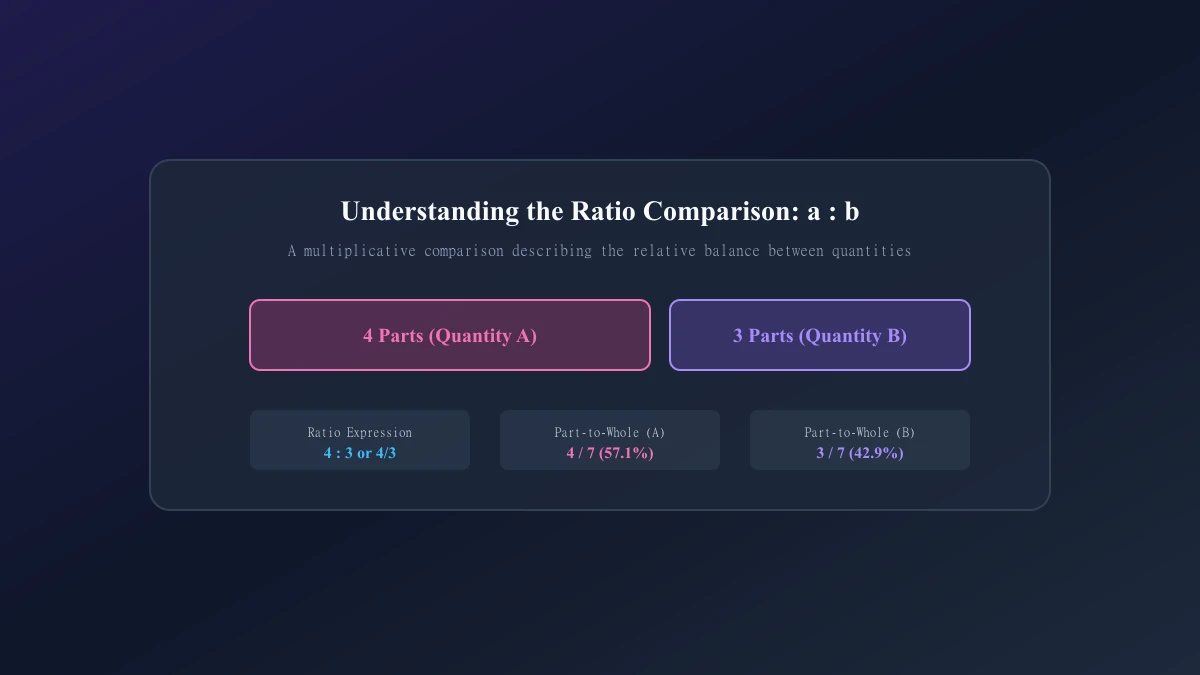
What Is a Ratio? Definition, Types, and Everyday Examples
Learn what is a ratio, how to read and write one, and how ratios differ from fractions, rates, and proportions, with everyday examples and practice questions.