
Ratio Finder: Calculate and Simplify Ratios Easily
Learn how to use a ratio finder to simplify numbers, solve missing values, compare ratios, and scale quantities, with clear examples and input checks to follow.

Table of Contents
- Quick Answer: Match the Tool to the Task
- What Can You Calculate From the Numbers You Have?
- How to Use a Ratio Finder Without Mixing Up the Inputs
- Decide What the First and Second Terms Represent
- Check Unit Consistency
- Follow the Field Format
- Read the Output: A Ratio Is Not Always a Percentage
- The Arithmetic Behind the Result
- Reducing to Simplest Form
- Producing an Equivalent Ratio
- Solving an Unknown Term
- Solve a Practical Missing-Value Problem
- Compare Offers and Plan Quantities
- Compare Two Ratios With Different Totals
- Divide Supplies Across Three Groups
- Work With Decimal Precision and Exact Values
- Know When a Ratio Solver Cannot Answer the Question
- Frequently Asked Questions
- Is a ratio finder the same as a ratio simplifier?
- Can a ratio contain zero?
- How can I check a result without another calculator?
- Can I convert a percentage directly into a ratio?
- Turn the Output Into a Usable Answer
A ratio finder helps you compare amounts, reduce a numerical relationship, or calculate an unknown quantity. The right input depends on the task: two numbers can establish a ratio, while a missing-value problem usually needs three known numbers arranged as $a:b = c:d$.
That distinction matters when you open an online calculator. A blank field may represent an unknown value, a scale factor, or a total to divide. Entering a correct number into the wrong field can still produce an answer, but it may answer a different question.
This guide explains how to choose the calculation, prepare your values, and interpret the result. It also covers situations where an exact-looking answer can be misleading, including rounded measurements, fractional object counts, and comparisons that are not truly proportional. The goal is to make the output useful beyond the calculator screen.
Quick Answer: Match the Tool to the Task
To find a ratio, enter the quantities in the order you want to compare them and select the appropriate operation. A calculator may simplify known values, generate equivalent ratios, or solve a missing term. Keep corresponding quantities aligned and check whether the result represents a comparison, an actual amount, or a share of a total.
What Can You Calculate From the Numbers You Have?
Before typing, identify the information already available. Different modes require different inputs, and features vary between tools:
| Your Information | Useful Mode | Expected Output |
|---|---|---|
| Two known quantities | Simplify | A reduced ratio |
| A ratio and a multiplier | Scale | A larger or smaller equivalent ratio |
| Three terms in $a:b = c:d$ | Solve missing value | The fourth term |
| Two complete ratios | Compare | Whether their relationships match |
| A ratio and a combined amount | Split total | The quantity allocated to each part |
For example, entering 84 and 126 in a simplifying tool returns 2:3. It describes their relative size; it does not tell you that the original amounts have become two and three.
An equivalent ratio calculator could instead multiply 84:126 by 2 and return 168:252. Both outputs are correct because they perform different tasks.
How to Use a Ratio Finder Without Mixing Up the Inputs
Most errors can be caught by writing a short description above each number.

Decide What the First and Second Terms Represent
Suppose a workshop has 14 instructors and 98 participants. To find the ratio between two numbers, first decide which comparison matters:
- $\text{Instructors} : \text{Participants} = 14:98 = 1:7$
- $\text{Participants} : \text{Instructors} = 98:14 = 7:1$
The second format may be more convenient for describing participants per instructor. Neither arrangement is automatically preferred; your labels determine the meaning.
Check Unit Consistency
Measurements of the same kind should use matching units before numerical reduction. If two parcels weigh 750 grams and 1.5 kilograms, enter 750 and 1,500 after converting kilograms to grams. The resulting mass ratio is 1:2.
However, a rate can deliberately compare different units (such as pages per minute). Preserve those units when interpreting the answer.
Follow the Field Format
Some tools accept fractions such as 7/8. Others accept only whole numbers or decimals. Check whether a scale field expects a multiplier, such as 1.5, or a percentage increase, such as 50%. Avoid using zero as a placeholder because zero is a numerical input with its own distinct meaning.
Read the Output: A Ratio Is Not Always a Percentage
A result panel may show several forms of the same comparison. Understanding each label prevents an easy mistake: assuming every displayed percentage means a share of the total.
Suppose an inventory contains 35 small notebooks and 49 large notebooks, with no other sizes.
| Output Label | Value | Interpretation |
|---|---|---|
| Small-to-large ratio | 5:7 | Five small notebooks for every seven large ones |
| Quotient | $5/7 \approx 0.7143$ | Small notebooks number about 0.7143 times the large ones |
| Small as a percentage of large | $\approx 71.43%$ | Small count divided by large count, multiplied by 100 |
| Small share of all notebooks | $5/12 \approx 41.67%$ | Small count divided by the combined count (part-to-whole) |
The first comparison is part-to-part. The final comparison is part-to-whole, so the denominator changes from seven parts to twelve total parts.
The Arithmetic Behind the Result
A ratio calculator uses familiar operations. Knowing the underlying calculation makes unexpected answers easier to diagnose:
Reducing to Simplest Form
For positive whole numbers $a$ and $b$, find their greatest common divisor $g$:
$$\text{Simplified ratio} = (a \div g):(b \div g)$$
For 84:126, $g = 42$, so the answer is 2:3.
Producing an Equivalent Ratio
Multiply every term by a common scale factor $k$:
$$a:b \to ka:kb$$
Solving an Unknown Term
To find a missing value in a ratio, write the corresponding comparisons as a proportion:
$$\frac{a}{b} = \frac{c}{d}$$
When $b$ and $d$ are nonzero, the cross-products must match:
$$ad = bc$$
If $d$ is unknown and $a$ is nonzero, rearrange to:
$$d = \frac{bc}{a}$$
Solve a Practical Missing-Value Problem
A stationery pack contains five dividers for every twelve labels. You have 84 labels and want to maintain that relationship. How many dividers are needed?

- Arrange matching quantities: $$\text{Dividers} : \text{Labels} = 5:12 = x:84$$
- Find the scale factor: $$84 \div 12 = 7$$
- Apply the factor to the dividers: $$x = 5 \times 7 = 35\text{ dividers}$$
- Verify with cross-products: $$5 \times 84 = 420 \quad \text{and} \quad 12 \times 35 = 420$$
If you enter $5:12 = 84:x$ instead, the problem changes to asking for labels needed with 84 dividers ($x = 201.6$). This is why correct arithmetic does not guarantee a correctly entered problem.
Compare Offers and Plan Quantities

Compare Two Ratios With Different Totals
Printer A produces 156 pages in six minutes. Printer B produces 225 pages in nine minutes.
- Printer A: $156 \div 6 = 26\text{ pages per minute}$
- Printer B: $225 \div 9 = 25\text{ pages per minute}$
Although Printer B prints more pages during its total run, Printer A maintains the higher output rate. Normalizing both comparisons to one minute clarifies the difference.
Divide Supplies Across Three Groups
A club allocates 660 craft sheets to three activities in a ratio of 2:4:5.
- Add the terms: $2 + 4 + 5 = 11\text{ total parts}$
- One part: $660 \div 11 = 60\text{ sheets}$
- Allocations: 120, 240, and 300 sheets.
Work With Decimal Precision and Exact Values
Large terms do not always mean the calculator failed to simplify. They may reflect exact numbers:
- $0.333:1$ as an exact terminating decimal becomes 333:1000. If you intended one-third, enter $1/3$ instead.
- For fractions, clear denominators first: $$\left(\frac{2}{5}\right) : \left(\frac{7}{10}\right) = 4 : 7$$ Multiplying both terms by 10 produces the whole-number comparison without rounding errors.
Know When a Ratio Solver Cannot Answer the Question
- A total without a split rule is insufficient: Knowing there are 90 objects does not identify the ratio between two categories without additional clues.
- Fixed fees break simple price scaling: If printing costs $8 plus $0.20 per page, 50 pages cost $18 while 100 cost $28. Doubling the pages does not double the cost due to the fixed setup fee.
- Ratios do not establish causation: Comparing output with hours worked describes a rate; it does not prove that doubling hours will double output.
Frequently Asked Questions
Is a ratio finder the same as a ratio simplifier?
The names overlap, but a ratio simplifier focuses on reducing terms to lowest form, while a broader ratio finder can solve missing values ($a:b = c:x$), scale proportions, or split totals.
Can a ratio contain zero?
Zero can describe an absent category (e.g., $0:8$, which reduces to $0:1$). However, the fraction $a/b$ is undefined when $b = 0$. The expression $0:0$ provides no meaningful comparison.
How can I check a result without another calculator?
Check cross-products: for $a:b = c:d$, verify that $a \times d = b \times c$. Also confirm that corresponding labels remain aligned.
Can I convert a percentage directly into a ratio?
Yes, but specify what is being compared. If 45% is category A and 55% is B, $A:B$ is 45:55 (9:11). The ratio of A to the whole collection is 45:100 (9:20).
Turn the Output Into a Usable Answer
A useful result includes quantity labels, units, and clear context. Before relying on a ratio finder, confirm that the selected mode matches your question and that inputs support the calculation.
BigTechies Editorial Team
The Ratio Solver editorial team specializes in clear, step-by-step mathematical guides, statistical analysis explanations, and practical calculation workflows for students, educators, and professionals.
Solve Any Ratio in Seconds With Our Free Calculator
Simplify whole numbers, fractions, and decimals, find missing values, or divide totals in proportional parts with verified instant accuracy.
Related Articles
Continue exploring practical calculation guides and tutorials
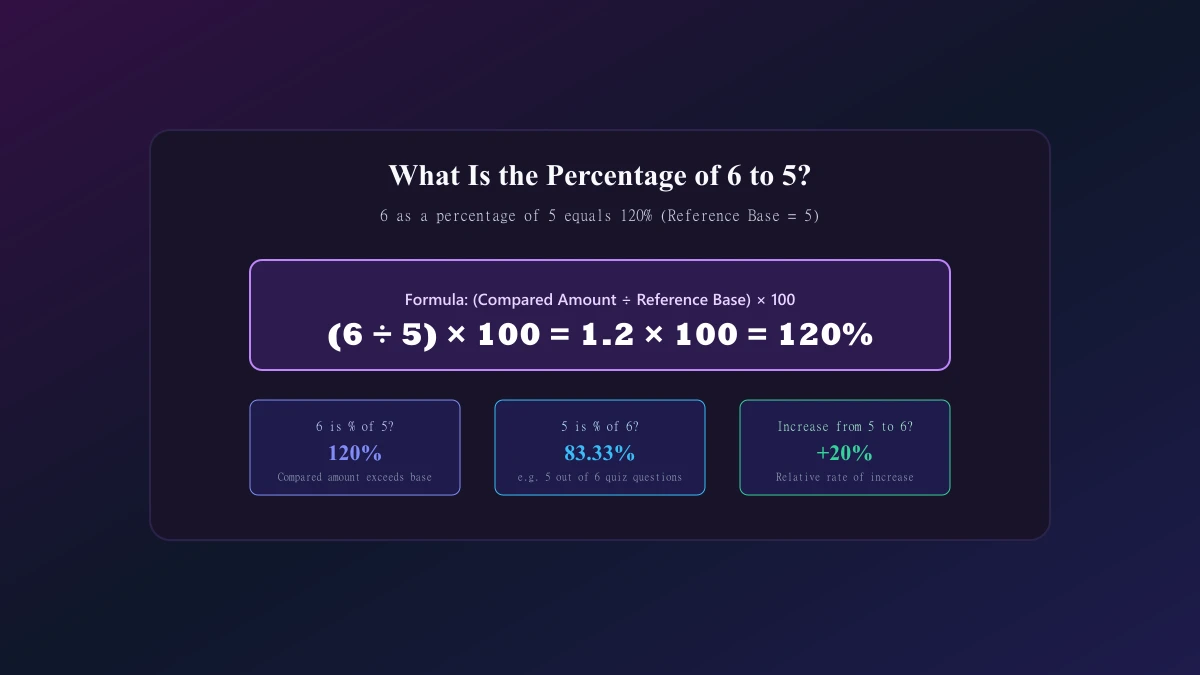
What Is the Percentage of 6 to 5? Answer With Easy Steps
Find out what is the percentage of 6 5 with clear steps and examples. Learn why the answer is 120%, how to reverse the calculation, and avoid common mistakes.
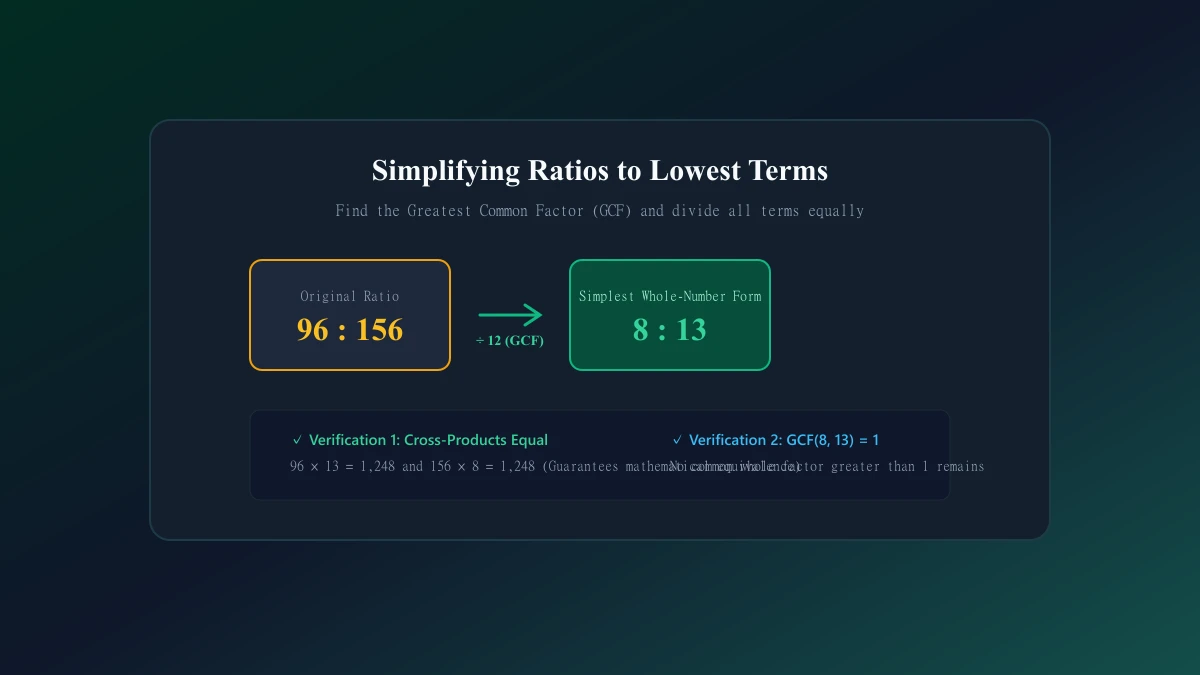
Ratio Simplifier: Reduce Ratios to Their Simplest Form
Use a ratio simplifier to reduce whole numbers, decimals, fractions, and three-part ratios. Learn GCF methods, check your answers, and avoid common mistakes.
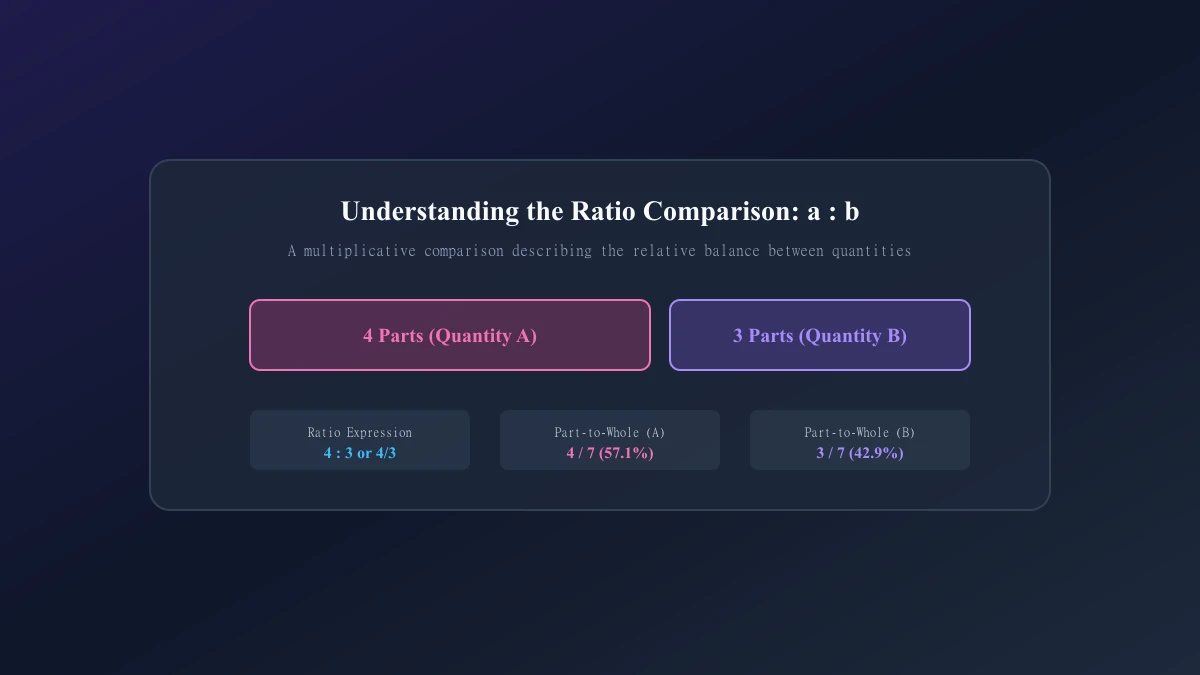
What Is a Ratio? Definition, Types, and Everyday Examples
Learn what is a ratio, how to read and write one, and how ratios differ from fractions, rates, and proportions, with everyday examples and practice questions.